History of Mars Hill Baptist Church
Mars Hill Baptist Church, founded in 1799 near Jennings Mill in what was then Jackson County, stands as one of northeast Georgia’s oldest and most storied congregations. Rooted in a spirit of faith and community, the church began with nine founding members—several of whom were Revolutionary War veterans—and grew steadily as settlers from Virginia and the Carolinas arrived. From humble gatherings in a one-room schoolhouse to the construction of four church buildings over two centuries, Mars Hill has been a beacon of spiritual devotion, resilience, and generosity. Its legacy includes support for African American churches following the Civil War, the founding of many of the Baptist churches in Oconee County, enduring recovery from a devastating fire in 1995, and continued service through ministries, education, and outreach into the present day. The church remains a pillar of fellowship, reflecting both its historical depth and ongoing mission to glorify God in every generation.
Founding the Church (1799)
Mars Hill Baptist Church was officially constituted on June 1, 1799, by a group of nine pioneering settlers meeting in a small schoolhouse near Jennings Mill in Jackson County, Georgia. The initial congregation included four men—John Stroud, Absolam/Absolom Autrey, Purnell Truitt, and Jacob Bankston—and five women—Sarah Stroud, Priscilla Hopkins, Jemima Bankston, Druey Clarkston, and Nancy Stone. All the male charter members were Revolutionary War veterans. Jacob Bankston, a veteran and one of the founders, served as the church’s first recorded pastor beginning in 1801.
Early Worship and Construction
The congregation met in the Jennings schoolhouse until 1800 when the group built a crude log building which stood on a gentle knoll about half mile from the present building. This church was the first Baptist house of worship in the western section of Clarke County. Later, in 1805, the church purchased land featuring a spring, an ideal site for baptisms, from Benjamin Haygood. The new church was built of hand-planed heart pine from trees logged nearby. Men and women sat on opposite sides of the center aisle. For winter baptisms, deacons warmed the spring water using heated rocks. Today, this tradition is creatively continued with hot water hoses to maintain the pool’s temperature.
Growth and Graves
As settlers from Virginia and the Carolinas flocked to the area, the church grew quickly, with more than 250 members joining between 1799 and 1810. Mars Hill welcomed master and slave alike into its fellowship. Among the first members was a slave named Neptune. It is believed that many of the unmarked fieldstone graves in the woods behind the original graveyard belong to enslaved members. Despite efforts in the mid-20th century, no inscriptions were found on these stones.
New Buildings and Expanding the Mission
By 1850, the congregation had outgrown its second building. Under Pastor Bedford Langford’s leadership, construction on a third church began, culminating in its completion in 1857. The earlier building was torn down and its location absorbed into the church cemetery. Mars Hill continued to influence the region, helping to establish churches like Bethabara Baptist in 1844, created for members who found travel to Mars Hill difficult.
Division Over the Mission of the Church and “Foot Washing”
In 1836, a conflict arose between those in the church who wanted to support missionaries, Sunday Schools, and Baptist higher education (Mercer University) and those who did not. The issue of “foot washing” as an ordinance was often one of the defining issues between the “Primitive Baptists” (anti-missionary) and the Missionary Baptists. This division not only occurred at MHBC, but in scores of churches across Georgia. This divergence of opinion among members led to a 20-year period during which two congregations alternated worship in the same building. Ultimately, the Primitive Baptist at Mars Hill Church branched off in 1856 and relocated to a site near where Mount Zion Primitive Baptist Church now stands.
Civil War Challenges and Community Support
The Civil War era brought significant hardship, but also opportunities for outreach. After emancipation, the formerly enslaved members sought help in forming independent congregations. Mars Hill’s members responded with generosity, helping to establish Shady Grove, Chestnut Grove, and Mount Zion Baptist Churches.
20th Century Milestones
The church celebrated its Sesquicentennial in 1949 with a two-day event led by Pastor J.S. Hays. Under his guidance, a new Sunday School annex was completed in 1958. During Rev. William Nash’s tenure, a sanctuary expansion and dedication took place in 1967. The Claude Healan Annex was completed in 1975, and Briarwood Baptist Church was launched as a mission church in 1981.
Fire and Renewal
On September 14, 1995, a lightning strike destroyed the historic sanctuary. The congregation swiftly adapted, holding services in the Claude Healan Annex the very next Sunday. Two years later, on the anniversary of the fire, Mars Hill dedicated its fourth and current church building. In 1999, the church celebrated its bicentennial with services, events, and baptisms in the original spring-fed pool.
Modern Developments
Under Rev. Charles Jones (1999–2009), the church experienced its highest membership and attendance levels, with membership surpassing 1000 and regular attendance of over 400. An educational building was completed in 2006, housing a preschool academy, gym, and commercial kitchen. In 2021, Pastor Rick Brittain led the church in a “note burning ceremony” after paying off the Family Life Building loan, allowing for interior updates completed in 2024.
Legacy and Continuity
With deep roots and enduring faith, Mars Hill Baptist Church remains a vital part of the community it helped shape. Descendants of the original 1799 members continue to call Oconee County home, and the church continues to serve as a spiritual anchor, glorifying God through every generation.
Cemetery
In 2026, the cemetery was photographed and mapped using a drone, GPS, and ground penetrating radar. The result is an interactive map that is now available to the public here.
Mars Hill Baptist Church, founded in 1799 near Jennings Mill in what was then Jackson County, stands as one of northeast Georgia’s oldest and most storied congregations. Rooted in a spirit of faith and community, the church began with nine founding members—several of whom were Revolutionary War veterans—and grew steadily as settlers from Virginia and the Carolinas arrived. From humble gatherings in a one-room schoolhouse to the construction of four church buildings over two centuries, Mars Hill has been a beacon of spiritual devotion, resilience, and generosity. Its legacy includes support for African American churches following the Civil War, the founding of many of the Baptist churches in Oconee County, enduring recovery from a devastating fire in 1995, and continued service through ministries, education, and outreach into the present day. The church remains a pillar of fellowship, reflecting both its historical depth and ongoing mission to glorify God in every generation.
Founding the Church (1799)
Mars Hill Baptist Church was officially constituted on June 1, 1799, by a group of nine pioneering settlers meeting in a small schoolhouse near Jennings Mill in Jackson County, Georgia. The initial congregation included four men—John Stroud, Absolam/Absolom Autrey, Purnell Truitt, and Jacob Bankston—and five women—Sarah Stroud, Priscilla Hopkins, Jemima Bankston, Druey Clarkston, and Nancy Stone. All the male charter members were Revolutionary War veterans. Jacob Bankston, a veteran and one of the founders, served as the church’s first recorded pastor beginning in 1801.
Early Worship and Construction
The congregation met in the Jennings schoolhouse until 1800 when the group built a crude log building which stood on a gentle knoll about half mile from the present building. This church was the first Baptist house of worship in the western section of Clarke County. Later, in 1805, the church purchased land featuring a spring, an ideal site for baptisms, from Benjamin Haygood. The new church was built of hand-planed heart pine from trees logged nearby. Men and women sat on opposite sides of the center aisle. For winter baptisms, deacons warmed the spring water using heated rocks. Today, this tradition is creatively continued with hot water hoses to maintain the pool’s temperature.
Growth and Graves
As settlers from Virginia and the Carolinas flocked to the area, the church grew quickly, with more than 250 members joining between 1799 and 1810. Mars Hill welcomed master and slave alike into its fellowship. Among the first members was a slave named Neptune. It is believed that many of the unmarked fieldstone graves in the woods behind the original graveyard belong to enslaved members. Despite efforts in the mid-20th century, no inscriptions were found on these stones.
New Buildings and Expanding the Mission
By 1850, the congregation had outgrown its second building. Under Pastor Bedford Langford’s leadership, construction on a third church began, culminating in its completion in 1857. The earlier building was torn down and its location absorbed into the church cemetery. Mars Hill continued to influence the region, helping to establish churches like Bethabara Baptist in 1844, created for members who found travel to Mars Hill difficult.
Division Over the Mission of the Church and “Foot Washing”
In 1836, a conflict arose between those in the church who wanted to support missionaries, Sunday Schools, and Baptist higher education (Mercer University) and those who did not. The issue of “foot washing” as an ordinance was often one of the defining issues between the “Primitive Baptists” (anti-missionary) and the Missionary Baptists. This division not only occurred at MHBC, but in scores of churches across Georgia. This divergence of opinion among members led to a 20-year period during which two congregations alternated worship in the same building. Ultimately, the Primitive Baptist at Mars Hill Church branched off in 1856 and relocated to a site near where Mount Zion Primitive Baptist Church now stands.
Civil War Challenges and Community Support
The Civil War era brought significant hardship, but also opportunities for outreach. After emancipation, the formerly enslaved members sought help in forming independent congregations. Mars Hill’s members responded with generosity, helping to establish Shady Grove, Chestnut Grove, and Mount Zion Baptist Churches.
20th Century Milestones
The church celebrated its Sesquicentennial in 1949 with a two-day event led by Pastor J.S. Hays. Under his guidance, a new Sunday School annex was completed in 1958. During Rev. William Nash’s tenure, a sanctuary expansion and dedication took place in 1967. The Claude Healan Annex was completed in 1975, and Briarwood Baptist Church was launched as a mission church in 1981.
Fire and Renewal
On September 14, 1995, a lightning strike destroyed the historic sanctuary. The congregation swiftly adapted, holding services in the Claude Healan Annex the very next Sunday. Two years later, on the anniversary of the fire, Mars Hill dedicated its fourth and current church building. In 1999, the church celebrated its bicentennial with services, events, and baptisms in the original spring-fed pool.
Modern Developments
Under Rev. Charles Jones (1999–2009), the church experienced its highest membership and attendance levels, with membership surpassing 1000 and regular attendance of over 400. An educational building was completed in 2006, housing a preschool academy, gym, and commercial kitchen. In 2021, Pastor Rick Brittain led the church in a “note burning ceremony” after paying off the Family Life Building loan, allowing for interior updates completed in 2024.
Legacy and Continuity
With deep roots and enduring faith, Mars Hill Baptist Church remains a vital part of the community it helped shape. Descendants of the original 1799 members continue to call Oconee County home, and the church continues to serve as a spiritual anchor, glorifying God through every generation.
Cemetery
In 2026, the cemetery was photographed and mapped using a drone, GPS, and ground penetrating radar. The result is an interactive map that is now available to the public here.
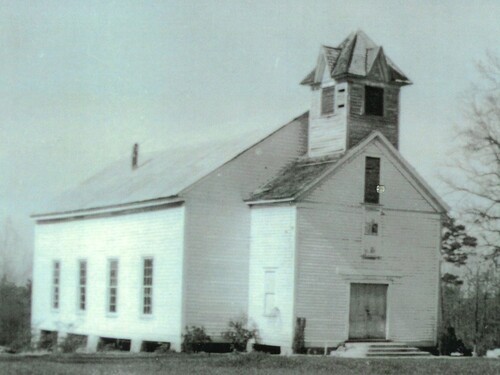
This photo was taken by Jack Griffith during Spring Revival in 1951. The first Mars Hill Baptist Church building was constructed on the knoll in front of the Virgil Langford home on Virgil Langford Road in 1799.
The second church building was constructed on the present site on Mars Hill Road in 1805/06.
The third building, the church shown in the picture, was completed in 1858 when Bedford Langford was pastor.
The second church building was constructed on the present site on Mars Hill Road in 1805/06.
The third building, the church shown in the picture, was completed in 1858 when Bedford Langford was pastor.
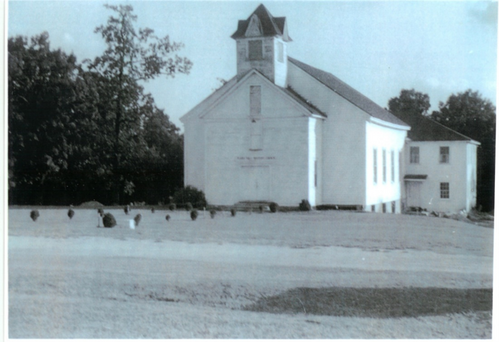
In the early 1950s, a Sunday School building program, led by Rev. J. S. Hays, began. The Sunday School Annex was completed in 1958. Later a basement was dug out to provide more Sunday School space.
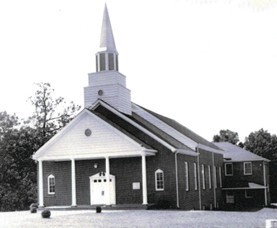
Under the leadership of Rev. Bill Nash, Mars Hill completed a renovation and expansion of the sanctuary in 1966. The sanctuary was lengthened by 25 feet and the interior completely renovated. A basement was added which contained eight classrooms, and three restrooms. A new steeple was erected on the front, and the outside was brick veneered. Central heat and air were installed. The grounds were landscaped. The renovated church was dedicated in 1967.
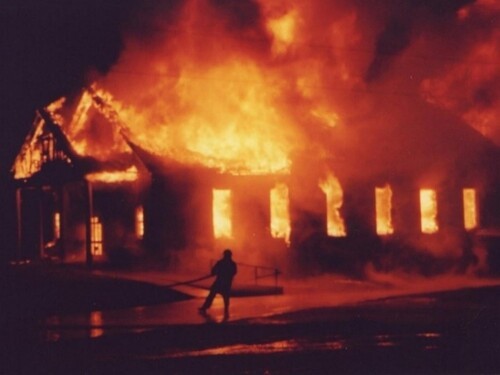
During a violent thunderstorm on the night of September 14, 1995, lightning struck the wooden steeple starting a fire that spread quickly through the old timbers. The Sanctuary and Sunday School Annex were a total loss. The Claude Healan Annex was spared.
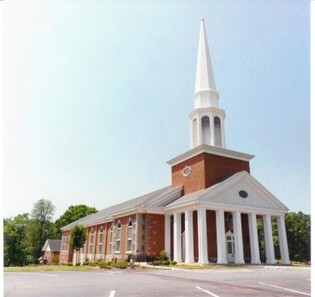
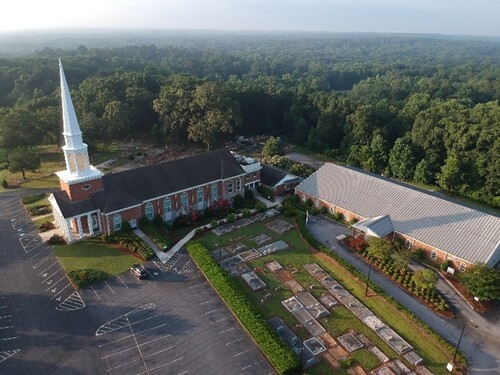
The new church building was dedicated on September 21, 1997, one year after the fire. The Life Building was dedicated on January 29, 2006.
Founding Members of Mars Hill Baptist Church
Revolutionary War soldiers were paid with free land
When the Revolutionary War broke out, the Continental Congress and the states had a problem. They needed men to fight but had no money to pay soldiers. To solve this problem, they turned to something America had plenty of at that time: land. Congress and states offered "bounty land" warrants—typically 100+ acres based on rank—redeemable for Western lands. The amount of land promised depended on the rank of the soldier. Privates or Noncommissioned Officers were promised 100–250 acres. Colonels were promised 500–800 acres. Major Generals were offered 1,100–15,000 acres. The land warrants could be redeemed by the soldier, his family, or individuals who purchased the warrants. Veterans, or their heirs, submitted proof of service such as discharge papers or sworn statements to receive the warrant. After the Revolutionary War, a massive influx of settlers, primarily from Virginia and the Carolinas, migrated into North Georgia seeking land, economic opportunity, and a new life. Many of these settlers traveled together as family groups. These families intermarried and founded churches wherever they settled.
Revolutionary War soldiers buried in Mars Hill Cemetery
Mars Hill Baptist Church was constituted on June 1, 1799 on Georgia’s frontier in Jackson County just 12 years after the approval of the US Constitution by the Constitutional Convention on September 17, 1787. These founders and early members of Mars Hill were veterans or wives of veterans who served in the Revolutionary War. During the Revolution the promise of bounty land was an incentive to enter and remain in the service, and after the war, bounty land grants became a form of reward for their service in the Revolution. Many veterans and their families came to Georgia seeking land and established churches in the communities where they settled.
Mars Hill Baptist Church Founding Members and Early Members Who Served in the Revolutionary War
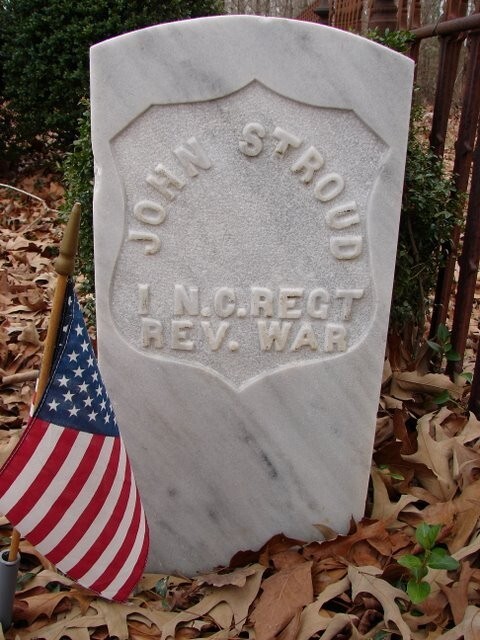
John Stroud, a Revolutionary War Soldier, was a Private in the 9th Regiment NC under Captain Sharp. He began his service in the 1st North Carolina Regiment under Major John Ashe on May 15, 1777. At this time Robert Howe was the commander of the Southern Department assigned to the Main Continental Army which included the 1st North Carolina Regiment. A DAR Marker for John Stroud was placed in the Mars Hill Cemetery by the Elijah Clarke Chapter of DAR in 2007.
John Stroud, son of Barnard John and Keziah Hannah Harker Stroud, was born on January 6, 1732. In the spring of 1756, he married Sarah Connelly, daughter of John Connelly and Margaret Oldham, b. 1735, d. December 17, 1807 in Clarke County, Georgia. Both John and Sarah Stroud are buried in the Mars Hill Cemetery. The Stroud family was part of the initial, tight-knit group of settlers who established Mars Hill Baptist Church on what was then the western edge of the Georgia frontier, near the Cherokee Nation in what was then Jackson County, Georgia. John and Sarah Connelly Stroud and seven other families established Mars Hill Church on June 1, 1799. He was ordained as a deacon at Mars Hill on July 13,1799 and was chosen to find the best place for a meeting house on February 13,1802. He died by drowning while fishing in the river with his son-in-law Stephen Crow on January 10,1805. He is the first person of record buried in the Mars Hill Cemetery. He is the direct ancestor of Amy Warren Sanders who compiled "History of the People of Mars Hill Baptist Church & Community 1799-1999” which was a continuation of the work of her mother, Mary Bondurant Warren.
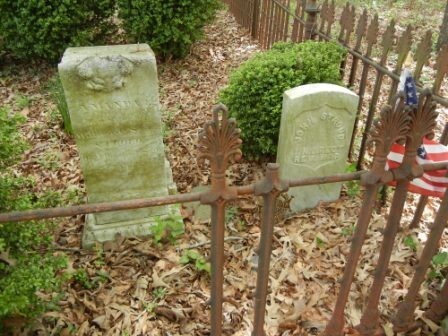
Note: According to a descendant, Stephen Crow and his father-in-law, John Stroud, went fishing. Stephen got drunk. John, who could not swim, fell into the river. Stephen was too drunk to save him, and John drowned. John’s wife and Stephen Crow’s mother-in-law would not allow him to be buried in the family plot. So, Stephen Crow’s grave is just outside the Stroud Family plot.
Jacob Bankston was born about 1760 in North Carolina and died in Louisiana between 1823 and 1830. In 1785, Jacob Bankston received a Bounty Grant of 288 acres in Wilkes County, Georgia for his Revolutionary War service in the Georgia Militia (Index to the Headright and Bounty Grants of Georgia, 1756-1909, p.28.) He along with other Revolutionary War veterans established the first church in Jackson County in 1788 known as Otoho Baptist Church on the North Oconee (Otoho) River and later renamed Oconee Baptist Church. (The Early History of Jackson County Georgia by Wilson, Gustavus James Nash, 1827-1909). He and his first wife, Jemima, were constituting members of Mars Hill Baptist Church. He was the first church clerk from 1799 to 1801 and the first recorded pastor of Mars Hill from July 18, 1801 to April 16, 1803. He served as pastor a second time from July 16, 1808 to July 15, 1809. In 1811, he deeded his property in Clarke and Wilkes counties to his son Elijah Bankston and stated he was moving to Mississippi with his second wife, Nancy Brewer. Jacob was listed as an ordained minister in 1822 when he was a delegate to the Pearl River Association from the Half-Moon Bluff Baptist Church on the Bogue Chitto River in Louisiana. (Patricia Osborn Green, organizing member of Apalachee DAR, is a direct descendant of Jacob Bankston through James Langford who married Hannah Annis Bankston).
William Daniell, Sr. was born November 25, 1743, in Hanover County, North Carolina. He served in the Revolutionary War under Col. Elijah Clarke and participated in the Battles of Kettle Creek and Kings Mountain and other engagements. In 1784, William Daniell received 287.5 acres in Franklin County, GA. William served as a Representative from Washington, Wilkes County, Georgia when the Constitution of the State was ratified in 1786.
In 1790, he built a new home for his 17-year-old bride, Mary (Polly) Melton, on Barber Creek in Jackson County, later Clarke County, and now Oconee County. This historic home is located on Founders Boulevard off Daniells Bridge Road in Oconee County, Georgia. He joined Mars Hill Church on January 9, 1802, and was ordained deacon on January 16, 1834. He had eleven children with his first wife, Rachel, and thirteen children with his second wife, Polly Melton. Two of his sons, James and Thomas, served in the Revolution.
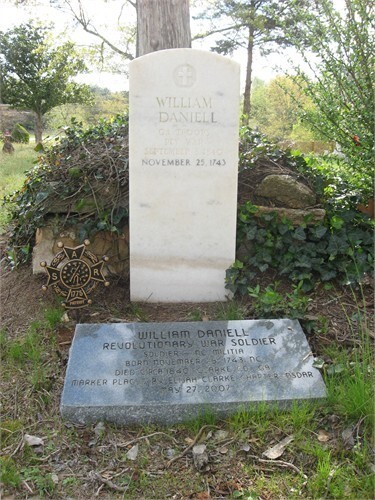
William Daniell died on September 5, 1840, at age 97. He is buried in Mars Hill Baptist Church Cemetery. On September 19, 1937, the Daughters of the American Revolution erected a tombstone at the gravesite recognizing Daniell as a Revolutionary War Soldier. A newer marker was placed by the Elijah Clarke Chapter of the DAR in 2007. (Tommie Elaine Perry Shattuck, an organizing member of the Apalachee DAR, is a direct descendant of William Daniell.)
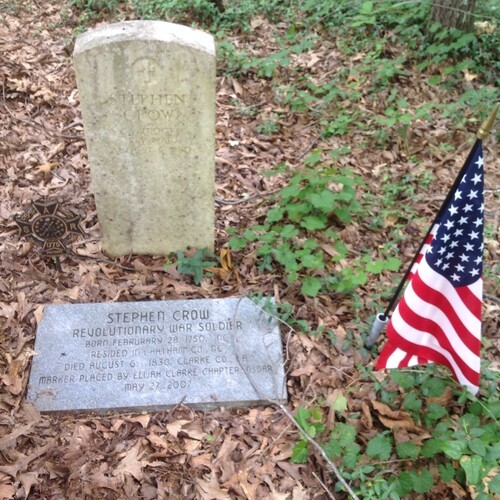
Stephen G. T. Crow, one of (at least) nine children of James Crow and Grace Denson, was born February 28, 1749/50 in Orange County, North Carolina and died in Clarke County, Georgia, August 6, 1830. In 1773 in Orange County, North Carolina, at the age of 23, Stephen married Margaret Stroud (born 1757; died 1838 in Clarke County, Georgia), the daughter of Revolutionary War soldier John Stroud and his wife Sarah. Stephen Crowe became a member of Mars Hill on March 6, 1804.
Stephen Crowe served in the Revolutionary War in North Carolina. He served in Chatham County, North Carolina where he was listed as Stephen Cron in Captain Isaiah Hogan's Company. His name was misspelled as was the names of his brothers, John, James, and Joshua. Both Stephen and his brother Isaac qualified to draw as Revolutionary War soldiers in the 1805 and 1827 Georgia land lotteries where he was identified as a Revolutionary War Veteran; GA Troops.
His grave was marked by a descendant in 1941, but this marking was not reported to the local DAR or to Congress. The grave was dedicated by the Elijah Clarke Chapter in June 1968. Apalachee Chapter DAR members descended from Stephen Crow are Linda Carol Crow Porterfield, Courtney Crow Boerrigter, and the late Shirley Crow Kennedy.
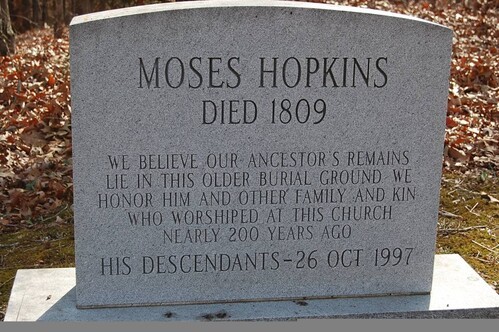
Moses Hopkins: A Memorial Stone was placed by the Hopkins family in the Mars Hill Cemetery which states “Moses Hopkins, died 1809, We believe our ancestor’s remains lie in this older burial ground. We honor him and other family and kin who worshiped at this church nearly 200 years ago. His Descendants - 26 Oct. 1997.” This memorial stone is placed in the lower part of the cemetery at the edge of the woods.
Moses Hopkins was born in 1760 and possibly served in the Talbot County, Maryland Militia; he took a loyalty oath in Maryland in 1778. He was received by experience (confession of faith) at Mars Hill on September 17, 1803. Moses died January 6, 1810, but his burial is not recorded at the church; however, as noted above his family believes he is buried in an unmarked grave at Mars Hill. (Daughters of the American Revolution, DAR Genealogical Research Databases “Record of Moses Hopkins” Ancestor A058105, database online at http://www/dar.org/)
Moses Hopkins’ mother, Priscilla (Bankston) Hopkins was a founding member of Mars Hill Baptist Church and the widow of Lambeth Hopkins who died in 1798 shortly before the founding of Mars Hill. He was a Revolutionary War patriot who moved from North Carolina to Wilkes County, Georgia, during the Revolutionary years. He is thought to have served with the Georgia militia with Capt. Carr in the Rangers of Wilkes County. He received bounty land for his military service in Washington County in the vicinity of the Oconee River and Briar Creek.
Benjamin J. Haygood was born on June 30, 1758, in Hillsborough, Orange, North Carolina, British Colonial America. His father was James George Haygood Sr, and his mother was Rebecca Elizabeth. He married Mary Ann Stewart on December 25, 1777, in Chatham, North Carolina, United States. They were the parents of at least five sons and four daughters. He joined the newly formed Mars Hill Baptist Church by letter on January 1,1801 and was ordained a deacon on Sept. 13, 1805. The present church sits on land purchased from Benjamin Haygood in 1805. A photograph of the original deed of 3 ½ acres is in the foyer of the church. Late in life he moved to Monroe County and died there on June 4, 1841. Many Haygood descendants stayed in the Clarke/Oconee County area and are prominent members of the Oconee County community.
Sons of the American Revolution application claims Benjamin was a private under Capt. George Herndon and Wilcox in General Folsom's regiment. He enlisted in 1775 in Chatham, North Carolina.
Although Abstract of Graves of Revolutionary Patriots, Vol.2 lists Mars Hills as his burial site, and the Mars Hill cemetery holds a marker, Benjamin's cemetery burial site is near Culloden in Monroe County, Georgia in the Haygood-Stroud family cemetery. Benjamin Haygood received a Revolutionary War Pension and a Bounty Land Grant for his service.
Purnall Truitt is not buried at Mars Hill but was a founding member of the church. Purnall was born in 1757 in Maryland and was the son of Riley Truitt and Margaret Newbold. His name comes from the maiden name of his grandmother Purnell. He was a Revolutionary War veteran who served in the Delaware Continental Regiment, Patten’s Company from May 1778 until February 1780. During his service, he was wounded and was reported Missing in Action and spent time as a Prisoner of War. Purnall Truitt applied for pension September 5, 1832 from Wilkes County, Georgia at the age of 77 years. He died in 1841 and is buried in the Camden Revolutionary War Cemetery, Camden, Kershaw County, South Carolina. He is a recognized patriot by the Daughters of the American Revolution (DAR) (Ancestor #A116465) and the Sons of the American Revolution (SAR). He was a prominent figure in the early Baptist church in Georgia. He is believed to have been one of the founding members of Sardis Baptist Church in Wilkes County, Georgia. In 1799, he was also a founding member of Mars Hill Baptist Church in Jackson County, Georgia.
Alexander Autry signed as a witness to the founding of Mars Hill Baptist Church on June 1, 1799. Alexander Autrey was born in 1743 in Edgecombe County, North Carolina. He was a son of Cornelius Autrey, Sr. and Elizabeth Paige Culbreth. Alexander and three of his brothers (Absalom, Jacob, and John) headed "West" and ended up in Georgia. Most of them married while still in North Carolina and settled in Wilkes County, Georgia, prior to 1773, when the first land sales went into effect. Some, if not all, of them enlisted in the Georgia militia. The records indicate that Alexander was given 300 acres on Fishing Creek on October 15, 1773. Alexander later settled in Clarke County, Georgia. Alexander served as a Refugee Captain in the Revolutionary War, enlisted in the Wilkes County, Georgia militia, and served under General Elijah Clarke. He fought in the Battle of Kettle Creek, which took place on or near his own property along Kettle Creek. For his service, he was granted 500 acres of land, as a bounty, on March 25, 1784. Alexander's name was recorded as "Awtry" in his military records and land records. Also active in the military was Alexander's brother, John, who in 1788 was killed and scalped by Creek Indians near Scull Shoals on the Oconee River.
Absalom Autry (brother of Alexander Autry), a founding member of Mars Hill Baptist in 1799 and was made a deacon on August 18, 1801. He was born in 1750 in Mecklenburg County, North Carolina and was the oldest of the Autry of four brothers. Records indicate that he was a Tory officer during the Revolution. However, he made a Revolutionary War pension application number R531. He appeared in court in Henry County, Georgia, on January 21, 1833, at age 82, to apply for a pension under the Act of June 7, 1832. He claimed to have entered service in the spring of 1782 in Lincoln County, North Carolina, as a drafted soldier under Captain McClain, serving for three months guarding the frontier at "widow Russell's Station" on the Broad River. (The "R" in the file number R531 stands for "Rejected" or "Rejected Claim" in the context of the Southern Campaign Pension Statement archives, meaning he did not receive a pension.) He moved from North Carolina to South Carolina, to Greene County, Georgia, to Jackson County, Georgia, to Clarke County, Georgia and finally to Henry County, Georgia where the pension application was made (The History of Mars Hill Baptist Church by Amy Sanders).
Additional Autrey Family
Several members of the Autrey/Autry family, originally from North Carolina, served in the American Revolutionary War, primarily in the Georgia militia under Elijah Clark. These brothers were Alexander, John, and Jacob Autrey, and reported by some a Tory brother, Absalom Autrey. Captain John Cornelius Autrey (1741–1788) served under General Elijah Clark in Georgia and was awarded over 862 acres in Washington County, Georgia. Alexander Autrey (1743–1786) served in the Wilkes County Militia (Georgia) and received 300 acres on Fishing Creek in 1773. Jacob Autrey served in the Georgia militia alongside his brothers. Absalom Autrey served as a Tory officer during the war.
Captain John Autry passed away February 2, 1788 in North High Shoals, Oconee, Georgia, killed on the Oconee River, Greene County, Georgia. He was killed and scalped by Creeks Indians near Richland Creek . He was buried on the spot where he was killed.
Druery (Drusillar) Clarkston, a founding member of Mars Hill Baptist Church, was listed alongside foundational families like the Hopkins and Bankston in early 1800s records of the church. She was apparently married to Joseph Clarkston (who also appears on the 1798 Jackson County tax list) as evidenced by the fact that Joseph Clarkston was named as the guardian of Lambeth’s son Joseph in Lambeth’s will of 1898.
Nancy Stone, a founding member of Mars Hill Baptist Church, was married to William Stone whose will was probated in Jackson County, Georgia on June 23, 1800. Nancy Stone and Jacob Bankston were executors of William Stone’s will. There is probably a family relationship.
Notable early members of the church
Zadock Cook was born in Virginia and moved to Hancock County, Georgia in early life. He was one of the first white settlers in Clarke County, Georgia. Although he did not serve in the Revolution, he served as an Ensign in the Washington County Militia in 1793 and Captain of the Eleventh Company, Hancock County Militia, in 1796. He was a self-educated man and an early member of Mars Hill Baptist Church having joined before 1804. He was dismissed from Mars Hill at his own request in 1825. Cook was member of the Georgia House of Representatives in 1806, 1807, and again in 1822. He served in the Georgia Senate 1810-1814, 1823, and 1824. He was elected as a Republican to the 14th United States Congress to fill the vacancy caused by the resignation of Alfred Cuthbert. He was reelected to the 15th Congress and served from December 2, 1816, to March 3, 1819. He rode a horse from Athens, Georgia to Washington, D.C. to attend congressional sessions. He retired from public life and settled on his plantation near Watkinsville, Georgia and engaged in agricultural pursuits until his death in 1863. He is buried in the Jackson Cemetery on Ruth Jackson Road, Bogart, Georgia. Marie Cooper Saxon (Apalachee Chapter DAR), daughter of Betty Cook Cooper, is a descendant.
Joseph East, an Englishman, and wife Milly were early members of Mars Hill. He was elected deacon on 9/15/1811. He left the community in 1820 and moved to Alabama.
The town of Eastville is named after his son, Silas East. In 1820, the whole East family (except Silas) left Georgia for Alabama, Arkansas, and other states. However, Silas stayed and became the patriarch of the East family in Georgia. He married Harriet Canty Houze, a member of Mars Hill Baptist Church, in Clarke County, Georgia in 1825. He was a wagonmaker and farmer and created significant financial standing by 1840. His wife, Harriet, died in 1846. He raised three daughters and three sons only to lose two sons to the Civil War. The two sons, Silas Jr. (Hollywood Cemetery, VA) and William (Oakwood Cemetery, VA), each died in the Civil War and Silas collected pensions for both. Darius East was his only son to return from the War. His headstone was missing from the gravesite for over 50 years and was found in the backyard of an elderly woman living in Eastville. His gravestone is incorrectly spelled as Salias East. The East Cemetery was restored in 2006.
When the Revolutionary War broke out, the Continental Congress and the states had a problem. They needed men to fight but had no money to pay soldiers. To solve this problem, they turned to something America had plenty of at that time: land. Congress and states offered "bounty land" warrants—typically 100+ acres based on rank—redeemable for Western lands. The amount of land promised depended on the rank of the soldier. Privates or Noncommissioned Officers were promised 100–250 acres. Colonels were promised 500–800 acres. Major Generals were offered 1,100–15,000 acres. The land warrants could be redeemed by the soldier, his family, or individuals who purchased the warrants. Veterans, or their heirs, submitted proof of service such as discharge papers or sworn statements to receive the warrant. After the Revolutionary War, a massive influx of settlers, primarily from Virginia and the Carolinas, migrated into North Georgia seeking land, economic opportunity, and a new life. Many of these settlers traveled together as family groups. These families intermarried and founded churches wherever they settled.
Revolutionary War soldiers buried in Mars Hill Cemetery
Mars Hill Baptist Church was constituted on June 1, 1799 on Georgia’s frontier in Jackson County just 12 years after the approval of the US Constitution by the Constitutional Convention on September 17, 1787. These founders and early members of Mars Hill were veterans or wives of veterans who served in the Revolutionary War. During the Revolution the promise of bounty land was an incentive to enter and remain in the service, and after the war, bounty land grants became a form of reward for their service in the Revolution. Many veterans and their families came to Georgia seeking land and established churches in the communities where they settled.
Mars Hill Baptist Church Founding Members and Early Members Who Served in the Revolutionary War
John Stroud, a Revolutionary War Soldier, was a Private in the 9th Regiment NC under Captain Sharp. He began his service in the 1st North Carolina Regiment under Major John Ashe on May 15, 1777. At this time Robert Howe was the commander of the Southern Department assigned to the Main Continental Army which included the 1st North Carolina Regiment. A DAR Marker for John Stroud was placed in the Mars Hill Cemetery by the Elijah Clarke Chapter of DAR in 2007.
John Stroud, son of Barnard John and Keziah Hannah Harker Stroud, was born on January 6, 1732. In the spring of 1756, he married Sarah Connelly, daughter of John Connelly and Margaret Oldham, b. 1735, d. December 17, 1807 in Clarke County, Georgia. Both John and Sarah Stroud are buried in the Mars Hill Cemetery. The Stroud family was part of the initial, tight-knit group of settlers who established Mars Hill Baptist Church on what was then the western edge of the Georgia frontier, near the Cherokee Nation in what was then Jackson County, Georgia. John and Sarah Connelly Stroud and seven other families established Mars Hill Church on June 1, 1799. He was ordained as a deacon at Mars Hill on July 13,1799 and was chosen to find the best place for a meeting house on February 13,1802. He died by drowning while fishing in the river with his son-in-law Stephen Crow on January 10,1805. He is the first person of record buried in the Mars Hill Cemetery. He is the direct ancestor of Amy Warren Sanders who compiled "History of the People of Mars Hill Baptist Church & Community 1799-1999” which was a continuation of the work of her mother, Mary Bondurant Warren.
Note: According to a descendant, Stephen Crow and his father-in-law, John Stroud, went fishing. Stephen got drunk. John, who could not swim, fell into the river. Stephen was too drunk to save him, and John drowned. John’s wife and Stephen Crow’s mother-in-law would not allow him to be buried in the family plot. So, Stephen Crow’s grave is just outside the Stroud Family plot.
Jacob Bankston was born about 1760 in North Carolina and died in Louisiana between 1823 and 1830. In 1785, Jacob Bankston received a Bounty Grant of 288 acres in Wilkes County, Georgia for his Revolutionary War service in the Georgia Militia (Index to the Headright and Bounty Grants of Georgia, 1756-1909, p.28.) He along with other Revolutionary War veterans established the first church in Jackson County in 1788 known as Otoho Baptist Church on the North Oconee (Otoho) River and later renamed Oconee Baptist Church. (The Early History of Jackson County Georgia by Wilson, Gustavus James Nash, 1827-1909). He and his first wife, Jemima, were constituting members of Mars Hill Baptist Church. He was the first church clerk from 1799 to 1801 and the first recorded pastor of Mars Hill from July 18, 1801 to April 16, 1803. He served as pastor a second time from July 16, 1808 to July 15, 1809. In 1811, he deeded his property in Clarke and Wilkes counties to his son Elijah Bankston and stated he was moving to Mississippi with his second wife, Nancy Brewer. Jacob was listed as an ordained minister in 1822 when he was a delegate to the Pearl River Association from the Half-Moon Bluff Baptist Church on the Bogue Chitto River in Louisiana. (Patricia Osborn Green, organizing member of Apalachee DAR, is a direct descendant of Jacob Bankston through James Langford who married Hannah Annis Bankston).
William Daniell, Sr. was born November 25, 1743, in Hanover County, North Carolina. He served in the Revolutionary War under Col. Elijah Clarke and participated in the Battles of Kettle Creek and Kings Mountain and other engagements. In 1784, William Daniell received 287.5 acres in Franklin County, GA. William served as a Representative from Washington, Wilkes County, Georgia when the Constitution of the State was ratified in 1786.
In 1790, he built a new home for his 17-year-old bride, Mary (Polly) Melton, on Barber Creek in Jackson County, later Clarke County, and now Oconee County. This historic home is located on Founders Boulevard off Daniells Bridge Road in Oconee County, Georgia. He joined Mars Hill Church on January 9, 1802, and was ordained deacon on January 16, 1834. He had eleven children with his first wife, Rachel, and thirteen children with his second wife, Polly Melton. Two of his sons, James and Thomas, served in the Revolution.
William Daniell died on September 5, 1840, at age 97. He is buried in Mars Hill Baptist Church Cemetery. On September 19, 1937, the Daughters of the American Revolution erected a tombstone at the gravesite recognizing Daniell as a Revolutionary War Soldier. A newer marker was placed by the Elijah Clarke Chapter of the DAR in 2007. (Tommie Elaine Perry Shattuck, an organizing member of the Apalachee DAR, is a direct descendant of William Daniell.)
Stephen G. T. Crow, one of (at least) nine children of James Crow and Grace Denson, was born February 28, 1749/50 in Orange County, North Carolina and died in Clarke County, Georgia, August 6, 1830. In 1773 in Orange County, North Carolina, at the age of 23, Stephen married Margaret Stroud (born 1757; died 1838 in Clarke County, Georgia), the daughter of Revolutionary War soldier John Stroud and his wife Sarah. Stephen Crowe became a member of Mars Hill on March 6, 1804.
Stephen Crowe served in the Revolutionary War in North Carolina. He served in Chatham County, North Carolina where he was listed as Stephen Cron in Captain Isaiah Hogan's Company. His name was misspelled as was the names of his brothers, John, James, and Joshua. Both Stephen and his brother Isaac qualified to draw as Revolutionary War soldiers in the 1805 and 1827 Georgia land lotteries where he was identified as a Revolutionary War Veteran; GA Troops.
His grave was marked by a descendant in 1941, but this marking was not reported to the local DAR or to Congress. The grave was dedicated by the Elijah Clarke Chapter in June 1968. Apalachee Chapter DAR members descended from Stephen Crow are Linda Carol Crow Porterfield, Courtney Crow Boerrigter, and the late Shirley Crow Kennedy.
Moses Hopkins: A Memorial Stone was placed by the Hopkins family in the Mars Hill Cemetery which states “Moses Hopkins, died 1809, We believe our ancestor’s remains lie in this older burial ground. We honor him and other family and kin who worshiped at this church nearly 200 years ago. His Descendants - 26 Oct. 1997.” This memorial stone is placed in the lower part of the cemetery at the edge of the woods.
Moses Hopkins was born in 1760 and possibly served in the Talbot County, Maryland Militia; he took a loyalty oath in Maryland in 1778. He was received by experience (confession of faith) at Mars Hill on September 17, 1803. Moses died January 6, 1810, but his burial is not recorded at the church; however, as noted above his family believes he is buried in an unmarked grave at Mars Hill. (Daughters of the American Revolution, DAR Genealogical Research Databases “Record of Moses Hopkins” Ancestor A058105, database online at http://www/dar.org/)
Moses Hopkins’ mother, Priscilla (Bankston) Hopkins was a founding member of Mars Hill Baptist Church and the widow of Lambeth Hopkins who died in 1798 shortly before the founding of Mars Hill. He was a Revolutionary War patriot who moved from North Carolina to Wilkes County, Georgia, during the Revolutionary years. He is thought to have served with the Georgia militia with Capt. Carr in the Rangers of Wilkes County. He received bounty land for his military service in Washington County in the vicinity of the Oconee River and Briar Creek.
Benjamin J. Haygood was born on June 30, 1758, in Hillsborough, Orange, North Carolina, British Colonial America. His father was James George Haygood Sr, and his mother was Rebecca Elizabeth. He married Mary Ann Stewart on December 25, 1777, in Chatham, North Carolina, United States. They were the parents of at least five sons and four daughters. He joined the newly formed Mars Hill Baptist Church by letter on January 1,1801 and was ordained a deacon on Sept. 13, 1805. The present church sits on land purchased from Benjamin Haygood in 1805. A photograph of the original deed of 3 ½ acres is in the foyer of the church. Late in life he moved to Monroe County and died there on June 4, 1841. Many Haygood descendants stayed in the Clarke/Oconee County area and are prominent members of the Oconee County community.
Sons of the American Revolution application claims Benjamin was a private under Capt. George Herndon and Wilcox in General Folsom's regiment. He enlisted in 1775 in Chatham, North Carolina.
Although Abstract of Graves of Revolutionary Patriots, Vol.2 lists Mars Hills as his burial site, and the Mars Hill cemetery holds a marker, Benjamin's cemetery burial site is near Culloden in Monroe County, Georgia in the Haygood-Stroud family cemetery. Benjamin Haygood received a Revolutionary War Pension and a Bounty Land Grant for his service.
Purnall Truitt is not buried at Mars Hill but was a founding member of the church. Purnall was born in 1757 in Maryland and was the son of Riley Truitt and Margaret Newbold. His name comes from the maiden name of his grandmother Purnell. He was a Revolutionary War veteran who served in the Delaware Continental Regiment, Patten’s Company from May 1778 until February 1780. During his service, he was wounded and was reported Missing in Action and spent time as a Prisoner of War. Purnall Truitt applied for pension September 5, 1832 from Wilkes County, Georgia at the age of 77 years. He died in 1841 and is buried in the Camden Revolutionary War Cemetery, Camden, Kershaw County, South Carolina. He is a recognized patriot by the Daughters of the American Revolution (DAR) (Ancestor #A116465) and the Sons of the American Revolution (SAR). He was a prominent figure in the early Baptist church in Georgia. He is believed to have been one of the founding members of Sardis Baptist Church in Wilkes County, Georgia. In 1799, he was also a founding member of Mars Hill Baptist Church in Jackson County, Georgia.
Alexander Autry signed as a witness to the founding of Mars Hill Baptist Church on June 1, 1799. Alexander Autrey was born in 1743 in Edgecombe County, North Carolina. He was a son of Cornelius Autrey, Sr. and Elizabeth Paige Culbreth. Alexander and three of his brothers (Absalom, Jacob, and John) headed "West" and ended up in Georgia. Most of them married while still in North Carolina and settled in Wilkes County, Georgia, prior to 1773, when the first land sales went into effect. Some, if not all, of them enlisted in the Georgia militia. The records indicate that Alexander was given 300 acres on Fishing Creek on October 15, 1773. Alexander later settled in Clarke County, Georgia. Alexander served as a Refugee Captain in the Revolutionary War, enlisted in the Wilkes County, Georgia militia, and served under General Elijah Clarke. He fought in the Battle of Kettle Creek, which took place on or near his own property along Kettle Creek. For his service, he was granted 500 acres of land, as a bounty, on March 25, 1784. Alexander's name was recorded as "Awtry" in his military records and land records. Also active in the military was Alexander's brother, John, who in 1788 was killed and scalped by Creek Indians near Scull Shoals on the Oconee River.
Absalom Autry (brother of Alexander Autry), a founding member of Mars Hill Baptist in 1799 and was made a deacon on August 18, 1801. He was born in 1750 in Mecklenburg County, North Carolina and was the oldest of the Autry of four brothers. Records indicate that he was a Tory officer during the Revolution. However, he made a Revolutionary War pension application number R531. He appeared in court in Henry County, Georgia, on January 21, 1833, at age 82, to apply for a pension under the Act of June 7, 1832. He claimed to have entered service in the spring of 1782 in Lincoln County, North Carolina, as a drafted soldier under Captain McClain, serving for three months guarding the frontier at "widow Russell's Station" on the Broad River. (The "R" in the file number R531 stands for "Rejected" or "Rejected Claim" in the context of the Southern Campaign Pension Statement archives, meaning he did not receive a pension.) He moved from North Carolina to South Carolina, to Greene County, Georgia, to Jackson County, Georgia, to Clarke County, Georgia and finally to Henry County, Georgia where the pension application was made (The History of Mars Hill Baptist Church by Amy Sanders).
Additional Autrey Family
Several members of the Autrey/Autry family, originally from North Carolina, served in the American Revolutionary War, primarily in the Georgia militia under Elijah Clark. These brothers were Alexander, John, and Jacob Autrey, and reported by some a Tory brother, Absalom Autrey. Captain John Cornelius Autrey (1741–1788) served under General Elijah Clark in Georgia and was awarded over 862 acres in Washington County, Georgia. Alexander Autrey (1743–1786) served in the Wilkes County Militia (Georgia) and received 300 acres on Fishing Creek in 1773. Jacob Autrey served in the Georgia militia alongside his brothers. Absalom Autrey served as a Tory officer during the war.
Captain John Autry passed away February 2, 1788 in North High Shoals, Oconee, Georgia, killed on the Oconee River, Greene County, Georgia. He was killed and scalped by Creeks Indians near Richland Creek . He was buried on the spot where he was killed.
Druery (Drusillar) Clarkston, a founding member of Mars Hill Baptist Church, was listed alongside foundational families like the Hopkins and Bankston in early 1800s records of the church. She was apparently married to Joseph Clarkston (who also appears on the 1798 Jackson County tax list) as evidenced by the fact that Joseph Clarkston was named as the guardian of Lambeth’s son Joseph in Lambeth’s will of 1898.
Nancy Stone, a founding member of Mars Hill Baptist Church, was married to William Stone whose will was probated in Jackson County, Georgia on June 23, 1800. Nancy Stone and Jacob Bankston were executors of William Stone’s will. There is probably a family relationship.
Notable early members of the church
Zadock Cook was born in Virginia and moved to Hancock County, Georgia in early life. He was one of the first white settlers in Clarke County, Georgia. Although he did not serve in the Revolution, he served as an Ensign in the Washington County Militia in 1793 and Captain of the Eleventh Company, Hancock County Militia, in 1796. He was a self-educated man and an early member of Mars Hill Baptist Church having joined before 1804. He was dismissed from Mars Hill at his own request in 1825. Cook was member of the Georgia House of Representatives in 1806, 1807, and again in 1822. He served in the Georgia Senate 1810-1814, 1823, and 1824. He was elected as a Republican to the 14th United States Congress to fill the vacancy caused by the resignation of Alfred Cuthbert. He was reelected to the 15th Congress and served from December 2, 1816, to March 3, 1819. He rode a horse from Athens, Georgia to Washington, D.C. to attend congressional sessions. He retired from public life and settled on his plantation near Watkinsville, Georgia and engaged in agricultural pursuits until his death in 1863. He is buried in the Jackson Cemetery on Ruth Jackson Road, Bogart, Georgia. Marie Cooper Saxon (Apalachee Chapter DAR), daughter of Betty Cook Cooper, is a descendant.
Joseph East, an Englishman, and wife Milly were early members of Mars Hill. He was elected deacon on 9/15/1811. He left the community in 1820 and moved to Alabama.
The town of Eastville is named after his son, Silas East. In 1820, the whole East family (except Silas) left Georgia for Alabama, Arkansas, and other states. However, Silas stayed and became the patriarch of the East family in Georgia. He married Harriet Canty Houze, a member of Mars Hill Baptist Church, in Clarke County, Georgia in 1825. He was a wagonmaker and farmer and created significant financial standing by 1840. His wife, Harriet, died in 1846. He raised three daughters and three sons only to lose two sons to the Civil War. The two sons, Silas Jr. (Hollywood Cemetery, VA) and William (Oakwood Cemetery, VA), each died in the Civil War and Silas collected pensions for both. Darius East was his only son to return from the War. His headstone was missing from the gravesite for over 50 years and was found in the backyard of an elderly woman living in Eastville. His gravestone is incorrectly spelled as Salias East. The East Cemetery was restored in 2006.
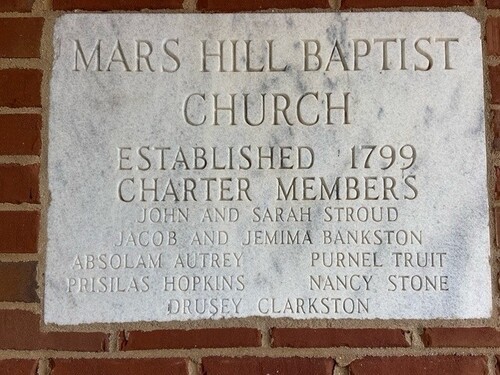
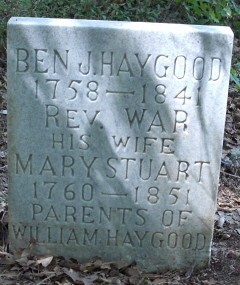
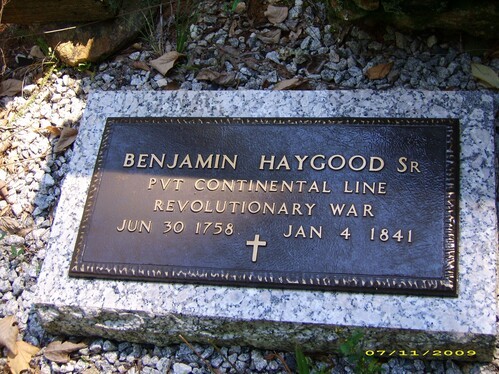
Monroe County grave site of Benjamin Haygood in Stroud Cemetery
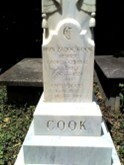
Zadock Cook's grave in Jackson Cemetery on Ruth Jackson Road, Bogart, Georgia